Table of Contents
- 1 Why Living With Less Feels Better — The Real Reason
- 2 The 6 Core Principles of Living With Less in India
- 3 Practical Areas to Simplify in Your Indian Home
- 4 A Month-by-Month Plan for Living With Less
- 5 What Living With Less Does Not Mean: How to live with less and feel more at home
- 6 Conclusion
- 7 Frequently Asked Questions
- 7.1 How do I convince my family to live with less when they disagree?
- 7.2 Is minimalism practical for an Indian home with many guests and family occasions?
- 7.3 What do I do with things I feel guilty about getting rid of?
- 7.4 How long does it take to see results from living with less?
- 7.5 Can living with less save money in India?
- 7.6 What is the difference between minimalism and just being tidy?
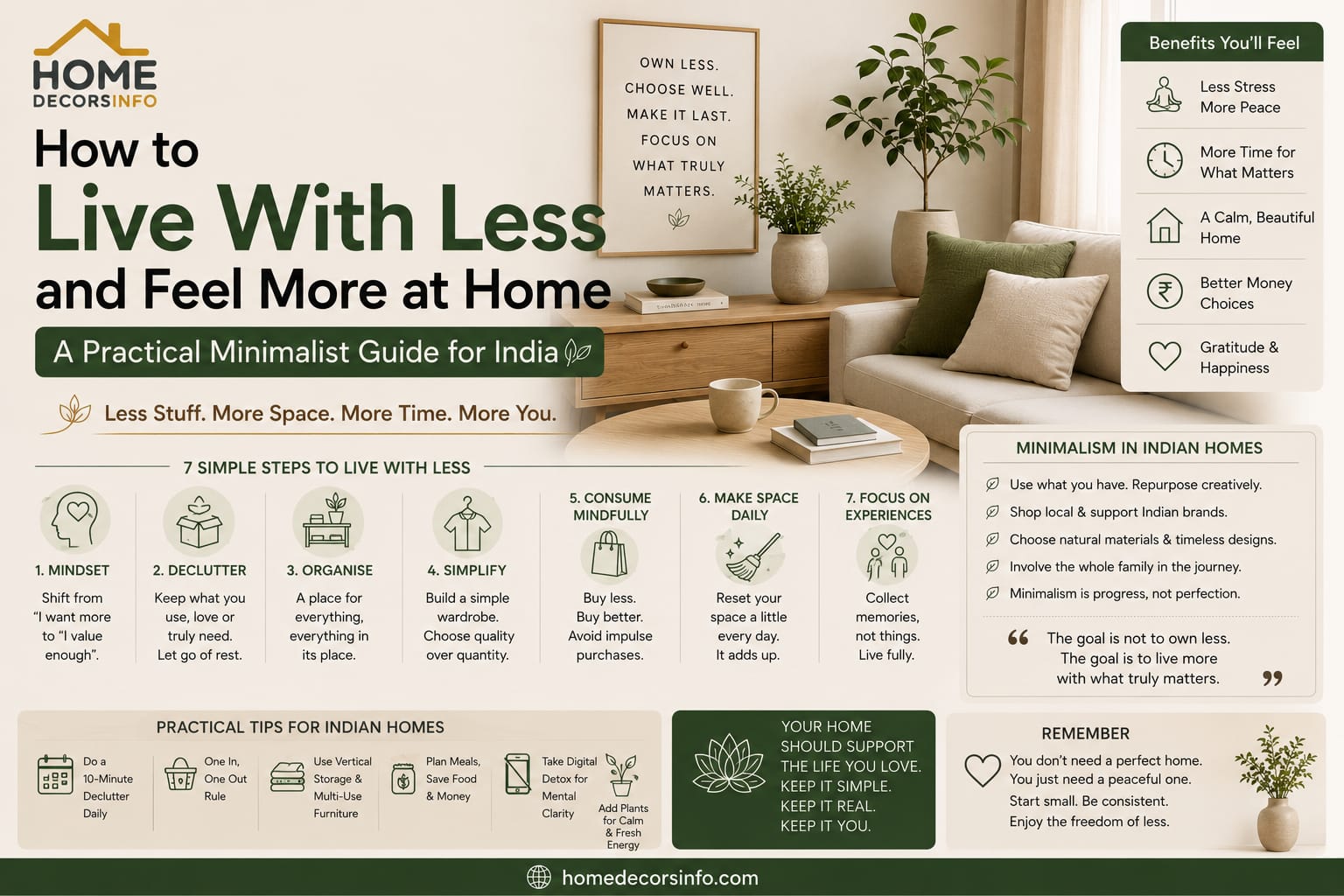
How to live with less and feel more at home: At some point most of us arrive at a realisation: the more we own, the more time and energy we spend managing, organising, cleaning, and thinking about our things — and the less time and energy we have for the parts of life that actually matter. It is a strange paradox that accumulating more stuff often produces not comfort or security, but a low-level, persistent sense of being overwhelmed by our own home.
Living with less is the practical antidote to this. It is not about deprivation or about turning your home into a showroom. It is about making a deliberate decision to own what genuinely serves your life and to release what does not — so that your home becomes a place that supports and restores you rather than one that quietly drains you. In India, where homes are often small, families are large, and storage space is perpetually at a premium, the case for living more intentionally with fewer possessions is especially compelling.
This guide covers how to live with less in a way that is practical for Indian households — accounting for joint families, festival traditions, limited budgets, and the specific material culture of Indian domestic life. There is no ideology here and no one-size-fits-all prescription. Just a set of principles and practical steps that work in real Indian homes.
Why Living With Less Feels Better — The Real Reason
Before getting into the how, it is worth being clear about the why — because the reason that living with less makes you feel better at home is not mystical or philosophical. It is practical and psychological.
Every object in your home that is not being used or loved represents an unfinished decision — a choice that was made (usually a purchase) but not fully resolved (because you have not decided whether you still want it). These unfinished decisions accumulate in the background of your awareness and create a mild but persistent cognitive load. Researchers in environmental psychology have consistently found that cluttered environments increase cortisol levels (the stress hormone) and reduce the ability to focus and feel at ease.
When you reduce the number of objects in your home to those that are genuinely used and valued, you eliminate thousands of these tiny background decisions. The result is a home that feels genuinely restful to be in — not because it looks like a design magazine, but because it no longer carries the quiet weight of all those unresolved choices.
The 6 Core Principles of Living With Less in India
1. Own Things Intentionally, Not Habitually
Most of what accumulates in Indian homes did not arrive through a single deliberate decision — it arrived through habit. The habit of keeping gifts even when they are not useful. The habit of buying something because it was on sale at a Big Bazaar or Meesho. The habit of replacing old items without removing them. The habit of keeping things “just in case”.
Living with less begins with replacing habitual ownership with intentional ownership. Before anything enters your home, the question is: does this genuinely serve my life, or am I acquiring it out of habit, social obligation, or impulse? It is a simple question but it changes purchasing behaviour dramatically when applied consistently.
This does not mean refusing gifts or never buying things on sale. It means being honest with yourself about what actually adds value and what simply adds volume.
2. Make Space Before Making Purchases
The most counterintuitive principle of living with less is also the most powerful: instead of buying storage solutions for the things you own, reduce the things you own until storage is no longer a problem. Most Indian homes do not have a storage problem — they have an accumulation problem. The solution is not more baskets, boxes, and cabinets. It is fewer things.
Before buying any organisational product — a new shelf, a wardrobe organiser, a storage ottoman — ask whether the problem could be solved by removing items rather than containing them. In most cases it can, and the result is a cleaner, more open space than any amount of clever storage would produce.
3. Apply the 90-Day Test to Uncertain Items
One of the most common barriers to living with less in Indian households is the emotional difficulty of letting things go — particularly items that were expensive, were gifted by family, or might theoretically be needed someday. The 90-day test is a practical way to resolve these uncertainties without the anxiety of making permanent decisions.
For any item you are unsure about, box it up and mark the box with today’s date. Store it out of sight — in a storeroom, under a bed, on a high shelf. If you have not opened the box or thought about the item in 90 days, you have your answer. Most people find they forget about the box entirely within a few weeks, making the final decision to let it go easy rather than agonising.
4. Distinguish Between Sentimental and Surplus
Indian family life involves significant quantities of objects that carry emotional meaning — items from parents and grandparents, festival decorations accumulated over decades, children’s artwork and school projects, wedding gifts. Living with less does not mean dismissing the emotional significance of these objects.
The useful distinction is between genuinely sentimental items — things that carry real meaning and that you would genuinely miss — and items that feel sentimental simply because they are old or were given by someone you love. A framed photograph of your grandmother and a set of matching decorative plates she gave you at your wedding are different things. One carries irreplaceable meaning. The other carries obligation. Learning to tell the difference, and releasing the obligation items with gratitude, is a significant part of learning to live with less in Indian households.
5. Involve the Whole Household — But Start With Yourself
In joint families and shared households, attempting to declutter other people’s belongings is a reliable way to create conflict rather than calm. The principle is clear: only work with your own things. Do not move, remove, or comment on items belonging to other family members unless explicitly asked.
What typically happens when one person in a household begins living more intentionally is that others become curious. As the spaces you are responsible for become calmer and more pleasant, the contrast with other areas of the home becomes visible. Conversations about simplifying naturally follow — on other people’s terms and at their own pace.
6. Buy Less, Buy Better
Living with less does not mean never buying anything. It means buying fewer things of better quality. A well-made cotton bedsheet that lasts ten years costs less over its lifetime than three poorly made ones that each last three years — and it feels better to sleep on, looks more beautiful, and contributes to a calmer home aesthetic throughout its life.
In India, “buying better” does not necessarily mean more expensive. It means more intentional — handloom cotton over synthetic, solid wood over particleboard, locally made over mass imported. It also means buying only what you actually need rather than what is on offer. The savings from buying fewer things of higher quality over time consistently exceed the savings from buying many cheaper things.
Practical Areas to Simplify in Your Indian Home
The Kitchen
Indian kitchens accumulate gadgets and utensils at a remarkable rate — pressure cookers in multiple sizes, individual appliances for each function, multiple sets of serving dishes, stacks of dabba containers and steel plates accumulated over years. A practical approach: identify the 20 per cent of kitchen items you use for 80 per cent of your cooking, and keep those accessible. Store the rest in deep storage and assess whether each is actually needed when you next encounter it.
A kitchen with clear counters and only daily-use items visible is faster to cook in, easier to clean, and genuinely more pleasant to be in. The discipline required is resisting the urge to fill every available surface and shelf — even when the items you could add are genuinely useful.
The Children’s Spaces
Children’s rooms and play areas in Indian homes often contain enormous quantities of toys, books, and activity materials — much of it not actually used. Research in child development consistently finds that children play more creatively and for longer with a smaller number of well-chosen toys than with a large collection that is constantly overwhelming their attention. Rotating toys — keeping some accessible and storing others — keeps the collection fresh and reduces the visual chaos of a toy-covered floor.
The Digital Home
Living with less applies to digital life as much as physical. The average Indian smartphone has 60 to 80 installed apps, most of which are used rarely or never. A digital declutter — removing unused apps, unsubscribing from email lists, organising photos into albums and deleting duplicates — creates the same quality of mental relief as a physical declutter. It also reduces screen time by removing the habit triggers that prompt mindless scrolling.
The Bedroom
The bedroom is the room in the home most directly connected to sleep quality — and a cluttered, visually busy bedroom consistently produces worse sleep than a calm, minimal one. This makes the bedroom one of the highest-priority spaces to simplify. A clear bedside table, a wardrobe that contains only clothes you actually wear, no items stored under the bed, and warm rather than harsh lighting are the four changes that make the most difference.
For a complete guide to the bedroom as a calm, restful space, daily minimalist habits that make your home feel more peaceful covers the bedroom and other rooms in practical detail. And for the living room specifically, 6 budget living room ideas for small homes in a modern Japanese style shows how a simpler, more considered living room can look without a large budget.
A Month-by-Month Plan for Living With Less
| Month | Focus Area | Primary Action |
|---|---|---|
| Month 1 | Wardrobe | Full audit — remove everything not worn in 12 months |
| Month 2 | Kitchen | Remove duplicate utensils, expired items, unused gadgets |
| Month 3 | Living room | Clear all surfaces, remove furniture not in regular use |
| Month 4 | Bedroom | Bedside table, under-bed storage, wardrobe maintenance |
| Month 5 | Bathroom | Replace plastic accessories, clear all surfaces |
| Month 6 | Digital | Phone apps, email inbox, photo library, social media |
| Ongoing | Maintenance | One-in-one-out rule, 90-day box, mindful purchasing |
What Living With Less Does Not Mean: How to live with less and feel more at home
Because the concept of minimalism has been so thoroughly aestheticised on social media and design blogs, it is worth being clear about what living with less does not require:
- It does not mean white walls and no decoration — colour, art, and personal objects all have a place
- It does not mean getting rid of festival items, family heirlooms, or culturally meaningful objects
- It does not mean your home looks like a hotel — it should look like yours, just with less excess
- It does not mean never buying anything — it means buying intentionally
- It does not mean everyone in your household has to be on board immediately — start with yourself
- It does not mean perfection — some days will be messier than others, and that is entirely normal
The goal is a home that serves your actual life better — not a home that looks a certain way on Instagram. For a practical starting point on reducing clutter room by room, how to declutter one room at a time without feeling overwhelmed is the natural first step.
Conclusion
Learning to live with less is one of the most genuinely life-improving things most people can do — not because owning less is inherently virtuous, but because the homes and lives that result from intentional simplicity are consistently calmer, more spacious, and more enjoyable to be in. The process is gradual, personal, and different for every household. There is no correct number of things to own, no perfect aesthetic to aim for. There is only the honest question: does this genuinely serve my life? Start with that question this weekend, applied to one drawer or one shelf, and see what the answer reveals.
Frequently Asked Questions
How do I convince my family to live with less when they disagree?
You cannot and should not try to convince family members to declutter their own belongings against their will. The most effective approach is to focus entirely on your own spaces and possessions, allow the results to speak for themselves, and invite rather than pressure. As the areas you manage become noticeably calmer and more functional, other family members often become genuinely curious and willing to try the approach in their own spaces. Patience and leading by example are far more effective than persuasion or pressure.
Is minimalism practical for an Indian home with many guests and family occasions?
Yes. Living with less does not mean living unprepared for guests or occasions. It means storing occasion items (extra crockery, festival decorations, guest bedding) in dedicated, organised storage rather than keeping everything accessible all the time. A home can accommodate large gatherings and frequent guests while still maintaining a calm, uncluttered daily atmosphere — the key is thoughtful storage of items used occasionally rather than displaying everything always.
What do I do with things I feel guilty about getting rid of?
Guilt about releasing objects is the most common obstacle in the decluttering process, particularly in Indian households where gifts and inherited items carry social and emotional weight. A practical approach: acknowledge the meaning of the item, take a photograph if it helps preserve the memory, and then donate it to someone who will use it. A gifted item sitting unused in a drawer is not being honoured — it is simply taking up space. Releasing it to where it will be used is a more respectful outcome than indefinite storage.
How long does it take to see results from living with less?
The first noticeable results appear within days of completing even a partial declutter of one area — typically a feeling of lightness, ease, and calm in that space that was not there before. The full compound effect, where the reduced cognitive load of a simplified home produces consistent improvement in mood and focus, typically becomes clear within four to six weeks of maintaining the changes. The process is cumulative — each area you simplify makes the whole home feel progressively better.
Can living with less save money in India?
Consistently and significantly. The primary saving comes from buying less — when you apply the 48-hour rule and intentional purchasing to all non-essential items, impulse spending drops dramatically. Secondary savings come from maintaining fewer items (fewer things to repair, replace, or store), from making better use of what you already own, and from the reduced desire to upgrade or replace items that come naturally with owning fewer, better-quality things. Most people who commit to living with less report spending noticeably less within the first three months.
What is the difference between minimalism and just being tidy?
Being tidy means organising and returning items to their places — it is a maintenance habit that keeps existing possessions orderly. Minimalism means making a deliberate choice about how much you own in the first place — reducing the total volume of possessions to what genuinely serves your life. A tidy home can still be overcrowded with things. A minimal home has already reduced the volume to the point where tidying takes very little time because there is simply less to tidy. The two work together: minimalism makes tidiness effortless rather than effortful.
—
Written by Sirisha Kumari for HomeDecorsInfo. What is the one area of your home where you feel the weight of too much stuff most acutely? I would love to hear where you plan to start — and what changes you notice first. Drop a comment below and share your experience with living with less.