Table of Contents
- 1 What to Look for in Indoor Plants for Indian Apartments
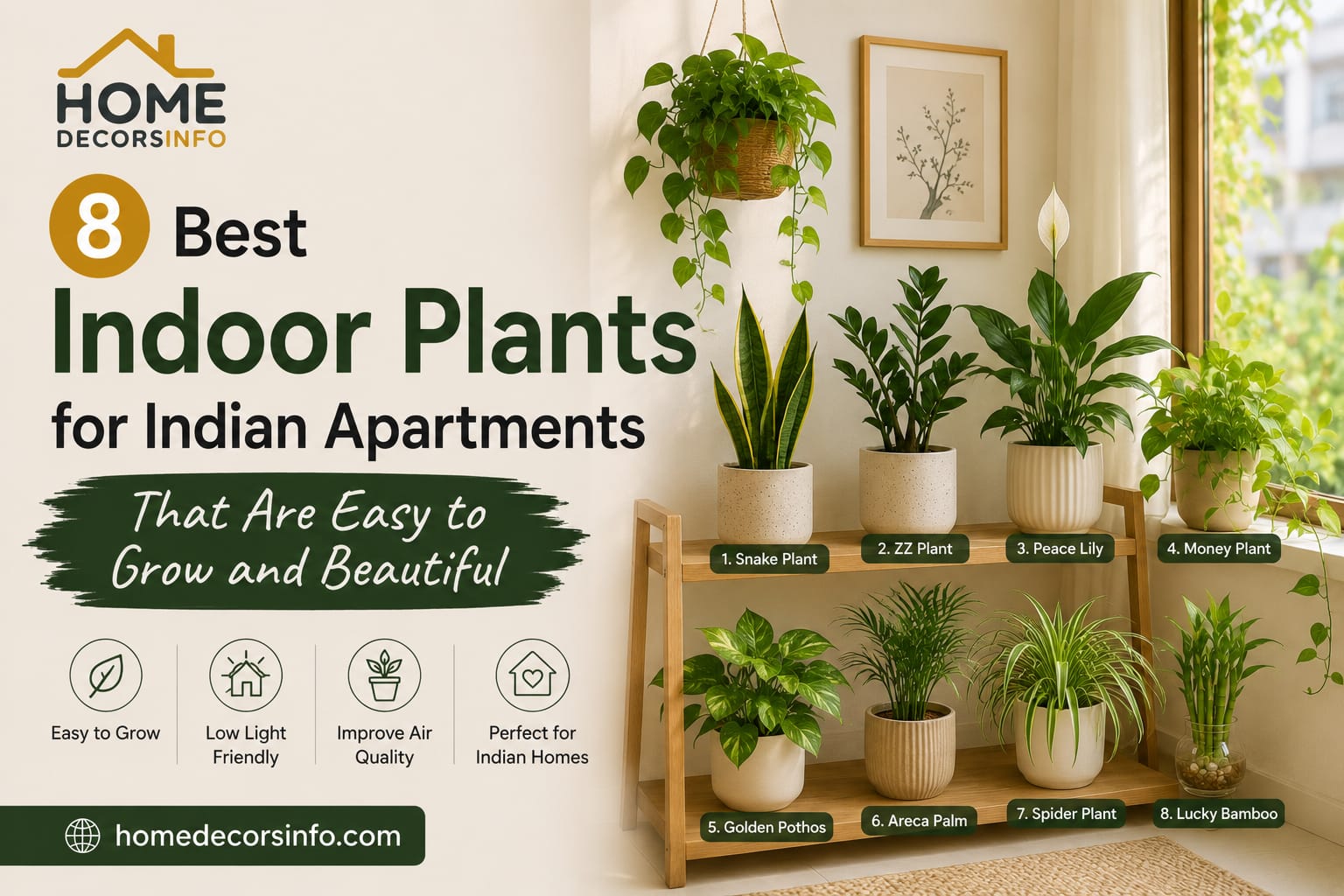
- 2 8 Best Indoor Plants for Indian Apartments
- 2.1 1. Snake Plant (Sansevieria / Mother-in-Law’s Tongue)
- 2.2 2. Money Plant (Pothos / Epipremnum aureum)
- 2.3 3. Peace Lily (Spathiphyllum)
- 2.4 4. Areca Palm (Dypsis lutescens)
- 2.5 5. Spider Plant (Chlorophytum comosum)
- 2.6 6. Jade Plant (Crassula ovata)
- 2.7 7. ZZ Plant (Zamioculcas zamiifolia)
- 2.8 8. Rubber Plant (Ficus elastica)
- 3 Quick Comparison: All 8 Plants at a Glance
- 4 Where to Buy Indoor Plants in India
- 5 Styling Your Indoor Plants the Japanese Way
- 6 Conclusion
- 7 Frequently Asked Questions
Plants make a home feel alive in a way that no amount of furniture or decoration can quite replicate. There is something about a living, growing thing in a room that softens the whole space — it makes the air feel cleaner, the light feel warmer, and the room feel genuinely inhabited rather than just decorated. For those of us living in Indian apartments, indoor plants are one of the most affordable, accessible, and rewarding ways to transform how a flat feels.
The challenge is choosing plants that actually survive Indian indoor conditions. Most apartments in cities like Mumbai, Hyderabad, Chennai, and Bengaluru have limited natural light, variable temperatures, humid summers and dry winters, and — in many buildings — no outdoor space at all. Not every plant can handle this. But a good selection can, and those plants tend to be the same ones that have been used in homes across India for generations: tough, beautiful, and easy to care for.
I have been keeping indoor plants for five years across two different apartments, and the eight plants in this guide are the ones I keep coming back to. They handle neglect, uneven watering, poor light, and the Indian monsoon humidity without complaint. They also happen to look beautiful — which is the point.
What to Look for in Indoor Plants for Indian Apartments
Before choosing any plant, it helps to understand what conditions you are actually working with. Indian apartments vary widely, but most share a few common characteristics that affect which plants will thrive:
- Light levels: Most Indian flats have windows on one or two sides, often facing east or west. Direct afternoon sun in summer can be intense; north-facing rooms can be very dim. Choose plants based on your actual light conditions, not the sunniest corner in the show flat.
- Temperature: Indoor temperatures in most Indian cities stay between 22°C and 38°C for most of the year — well within the comfort range of tropical plants. Avoid plants that need cold winters to rest.
- Humidity: Indian monsoon seasons bring high humidity, which most tropical plants love. Winter months in north India can get dry, which can stress some plants. Misting leaves occasionally helps during dry spells.
- Watering: The most common cause of indoor plant death in India is overwatering, not underwatering. Indian tap water is generally fine for most indoor plants. Let the soil dry partially between waterings for most species.
8 Best Indoor Plants for Indian Apartments
1. Snake Plant (Sansevieria / Mother-in-Law’s Tongue)
The snake plant is the most forgiving indoor plant you can own. It tolerates low light, irregular watering, and dry air with equal ease — and it grows in almost any indoor condition in India. Its upright, sword-shaped leaves in green and yellow tones have a clean, architectural quality that suits both modern and traditional home styles beautifully.
Snake plants are also one of the best plants for bedrooms because they produce oxygen at night (most plants do the opposite), making the air in a closed bedroom genuinely fresher. They are available at nurseries across India for ₹80 to ₹300 depending on size. They can survive weeks without watering and years without repotting — making them ideal for busy households or anyone new to keeping plants.
Light: Low to bright indirect light
Watering: Every 2–4 weeks in summer, once a month in winter
Best for: Bedroom, living room, any low-light corner
2. Money Plant (Pothos / Epipremnum aureum)
The money plant is perhaps the most iconic indoor plant in Indian homes. There is almost no house in India — from a high-rise apartment in Mumbai to a single-room flat in a small town — that does not have at least one money plant trailing from a shelf or sitting in a bottle of water on the kitchen windowsill. Its popularity is entirely deserved.
Money plants grow in soil or water, in low or bright light, and forgive almost any amount of neglect. Their trailing habit makes them beautiful on shelves, in hanging planters, or climbing a small trellis. They are available at almost every nursery and roadside plant seller across India for ₹20 to ₹100 — sometimes as a free cutting from a neighbour’s plant.
Light: Low to bright indirect light (avoid direct harsh sun)
Watering: Every 1–2 weeks in soil; change water weekly if growing in a bottle
Best for: Kitchen shelf, living room trailing from a bookcase, bathroom windowsill
3. Peace Lily (Spathiphyllum)
The peace lily is one of the most beautiful of all low-light indoor plants, producing elegant white flowers that last for weeks even in dim indoor conditions. It thrives in the kind of filtered light that is common in Indian apartments and is known to improve indoor air quality by absorbing common household pollutants.
One thing to know: peace lilies are thirsty plants. They will tell you when they need water by drooping their leaves slightly — and will perk back up within an hour or two of being watered. This visible communication makes them very easy to care for once you learn to read the signals. Available at garden centres and nurseries for ₹150 to ₹400.
Light: Low to medium indirect light — no direct sun
Watering: When top inch of soil is dry, approximately weekly
Best for: Living room, bedroom, bathroom with a window
4. Areca Palm (Dypsis lutescens)
For a statement plant that makes a real visual impact — filling a corner, adding height, and bringing a tropical, airy quality to the room — the areca palm is the best choice for Indian apartments. Its feathery, arching fronds look beautiful in larger rooms and are particularly well suited to the bright light conditions of west-facing Indian apartments where afternoon sun can be strong but not direct through a net curtain.
Areca palms are available in a range of sizes at nurseries across India, from small table plants at ₹200 to large floor plants at ₹800 to ₹2,000. They require a little more care than the other plants on this list — consistent moisture, occasional misting, and bright indirect light — but the visual payoff is significant. They are also one of the highest-rated air-purifying plants according to NASA’s Clean Air Study.
Light: Bright indirect light — near a window but not in direct harsh afternoon sun
Watering: Keep soil consistently moist but not waterlogged
Best for: Living room corner, near a bright window, large bedroom
5. Spider Plant (Chlorophytum comosum)
The spider plant is wonderfully adaptable and one of the best choices for Indian apartments that have variable or inconsistent light. It produces long, arching green-and-white striped leaves and sends out “spiderettes” — small baby plants on long stems — that look charming in a hanging planter or on a high shelf where they can trail downward.
Spider plants are completely non-toxic to children and pets, which makes them a practical choice for family homes. They also propagate very easily — the spiderettes can be cut and potted in fresh soil to create new plants — so one purchase can eventually provide plants for multiple rooms at no additional cost. Available at nurseries for ₹80 to ₹200.
Light: Low to bright indirect light
Watering: Every 1–2 weeks; allow soil to dry slightly between waterings
Best for: Hanging planters, high shelves, children’s rooms, kitchens
6. Jade Plant (Crassula ovata)
Jade plants are succulents — which means they store water in their thick, fleshy leaves and are highly drought-tolerant. In India, where forgetting to water a plant for two or three weeks is an easy and common occurrence, succulents have an obvious practical advantage. The jade plant specifically is a traditional favourite in Indian homes and is considered auspicious in many households.
It has a compact, tree-like shape that looks beautiful on a windowsill or as a desk plant, and can be trained over years into an impressive bonsai-style miniature tree. It needs more light than the other plants on this list — a bright south or west-facing windowsill is ideal. Available at nurseries for ₹80 to ₹250.
Light: Bright indirect to some direct light — near a sunny window
Watering: Every 2–4 weeks; let soil dry completely between waterings
Best for: Sunny windowsill, desk, bright kitchen counter
7. ZZ Plant (Zamioculcas zamiifolia)
The ZZ plant is the indoor plant for people who consider themselves bad at keeping plants. It grows in low light that would kill most other plants, survives months without watering (it stores water in its thick root rhizomes), handles air-conditioned dry air without complaint, and looks beautiful — with deep, glossy dark green leaves that have a polished, architectural quality.
The only downside: it grows slowly. But for a plant that requires almost zero maintenance and looks genuinely elegant, slow growth is a small compromise. It is becoming increasingly available at nurseries and plant shops in Indian metros, usually for ₹200 to ₹500.
Light: Low to medium indirect light — handles dim conditions very well
Watering: Every 3–5 weeks; highly drought-tolerant
Best for: Dark corners, offices, rooms with minimal windows, air-conditioned spaces
8. Rubber Plant (Ficus elastica)
The rubber plant has had a significant revival in recent years as Indian interior design has moved toward Japanese-inspired and minimalist aesthetics. Its large, oval, deep green or burgundy leaves have a bold, graphic quality that looks striking as a single statement plant in a living room corner or beside a reading chair. It has the visual presence of a large plant without requiring as much care as an areca palm.
Rubber plants do best in bright indirect light and moderately consistent watering — not too wet, not too dry. Wipe the large leaves with a damp cloth every few weeks to remove dust, which can otherwise block light and reduce the plant’s health. Available at nurseries and plant shops for ₹200 to ₹800 depending on size.
Light: Bright indirect light — near a window but not in direct harsh sun
Watering: When top 2 cm of soil is dry, approximately every 1–2 weeks
Best for: Living room corner statement plant, beside reading chairs, home office
Quick Comparison: All 8 Plants at a Glance
| Plant | Light Needed | Watering Frequency | Price Range | Best Room |
|---|---|---|---|---|
| Snake Plant | Low–Bright indirect | Every 2–4 weeks | ₹80–₹300 | Bedroom / any room |
| Money Plant | Low–Bright indirect | Every 1–2 weeks | ₹20–₹100 | Kitchen / living room |
| Peace Lily | Low–Medium indirect | Weekly | ₹150–₹400 | Living room / bedroom |
| Areca Palm | Bright indirect | Keep moist | ₹200–₹2,000 | Living room corner |
| Spider Plant | Low–Bright indirect | Every 1–2 weeks | ₹80–₹200 | Hanging / shelf |
| Jade Plant | Bright indirect–Some direct | Every 2–4 weeks | ₹80–₹250 | Sunny windowsill |
| ZZ Plant | Low–Medium indirect | Every 3–5 weeks | ₹200–₹500 | Dark corners / office |
| Rubber Plant | Bright indirect | Every 1–2 weeks | ₹200–₹800 | Living room corner |
Where to Buy Indoor Plants in India
Local nurseries are always the best first option — plants bought locally are already acclimatised to your city’s conditions, and nursery staff can give specific advice about which plants do well in your area. Most cities have nursery clusters: Sadashivanagar in Bengaluru, Aarey Colony in Mumbai, and Jubilee Hills nursery cluster in Hyderabad are well-known examples.
For online purchases, Ugaoo and Nurserylive are two of India’s most reliable plant delivery services, with good quality control and proper packaging to prevent transit damage. Amazon India also has a growing selection of indoor plants, though quality varies by seller — check reviews carefully.
For pots and planters, terracotta pots from local pottery markets are the most practical and aesthetically pleasing option for Indian apartments. They are breathable (good for plant roots), affordable (₹30 to ₹200 depending on size), and look naturally beautiful in both minimalist and traditional Indian interior styles.
Styling Your Indoor Plants the Japanese Way
Buying the plant is only half the work — where you put it and how you display it matters just as much. Japanese plant styling is built around the idea of single, intentional placement: one beautiful plant in a considered spot creates more impact than five plants scattered across every available surface.
For ideas on how to display plants as part of a calm, considered interior, Japanese plant styling ideas for living rooms and bedrooms covers specific placement and pot pairing ideas in detail. And for choosing the right pots and planters to complete the look, small planter decoration ideas for apartments and small spaces has a range of beautiful and affordable options suited to Indian homes.
The National Horticulture Board of India also provides useful guidance on indoor plant care suited to Indian climate conditions at nhb.gov.in — a helpful reference especially for first-time plant owners.
Conclusion
Adding indoor plants to your apartment is one of the simplest, most affordable, and most genuinely rewarding things you can do for the quality of your living space. The eight plants in this guide are all well suited to Indian apartment conditions, available at nurseries across the country, and beautiful enough to stand on their own as decor. Start with one plant in the room where you spend the most time. Give it a good pot, the right light, and the right amount of water — and let it settle in. A few weeks later, that single plant will have made enough difference that you will want to find space for a second.
For a more complete approach to creating a green, calm home interior, minimalist plant decor ideas for small spaces and modern homes is a natural next read.
Frequently Asked Questions
Which indoor plant is best for a dark Indian apartment?
The ZZ plant and snake plant are the two best choices for genuinely low-light conditions. Both can survive in rooms with minimal natural light and will continue to grow slowly even in dim conditions. The money plant and peace lily are also good in low light, though they appreciate a little more brightness when available. Avoid succulents and cacti in dark rooms — they need good light to thrive.
How often should I water indoor plants in Indian summer?
Frequency varies by plant, but as a general rule, most indoor plants in Indian summer conditions need watering every seven to fourteen days. Check the top inch or two of soil — if it feels dry, water thoroughly until it drains from the bottom of the pot. In the intense summer heat of cities like Delhi, Nagpur, or Hyderabad, some plants may need water more frequently. The best practice is to check the soil rather than water on a fixed schedule.
Can I grow indoor plants without any natural light?
Very few plants can truly thrive with zero natural light. However, grow lights — available on Amazon India for ₹500 to ₹2,000 — can supplement or partially replace natural light for plants. The ZZ plant and snake plant are the most tolerant of very low artificial-only light conditions. For most plants, even a small amount of indirect natural light from a distant window will make a meaningful difference.
Are indoor plants safe around children and pets?
Several popular indoor plants are mildly or moderately toxic if ingested, including peace lilies, rubber plants, and pothos (money plants). For homes with young children or pets that chew on things, the safest choices are spider plants, areca palms, and snake plants, which are non-toxic or have very low toxicity. Always keep plants out of reach of small children regardless of the plant’s toxicity level.
What is the best pot for indoor plants in India?
Terracotta pots are the best all-round choice for Indian conditions. They are porous, allowing excess moisture to evaporate from the sides, which reduces the risk of root rot — the most common cause of indoor plant death in humid Indian conditions. They are also inexpensive, widely available, and look naturally beautiful in both traditional and minimalist Indian interiors. Use a saucer underneath to p