Table of Contents
- 1 Why Growing Herbs Indoors Works Especially Well in India
- 2 What You Need to Get Started
- 3 The 7 Best Herbs to Grow Indoors in Indian Apartments
- 3.1 1. Tulsi (Holy Basil — Ocimum tenuiflorum)
- 3.2 2. Pudina (Mint — Mentha)
- 3.3 3. Hara Dhaniya (Fresh Coriander — Coriandrum sativum)
- 3.4 4. Curry Patta (Curry Leaf Tree — Murraya koenigii)
- 3.5 5. Hari Mirch (Green Chilli — Capsicum annuum)
- 3.6 6. Ajwain (Carom / Bishop’s Weed — Trachyspermum ammi)
- 3.7 7. Methi (Fenugreek — Trigonella foenum-graecum)
- 4 Setting Up Your Indoor Herb Garden: Step-by-Step
- 5 Quick Reference: All 7 Herbs at a Glance
- 6 Common Problems and How to Fix Them
- 7 Conclusion
- 8 Frequently Asked Questions
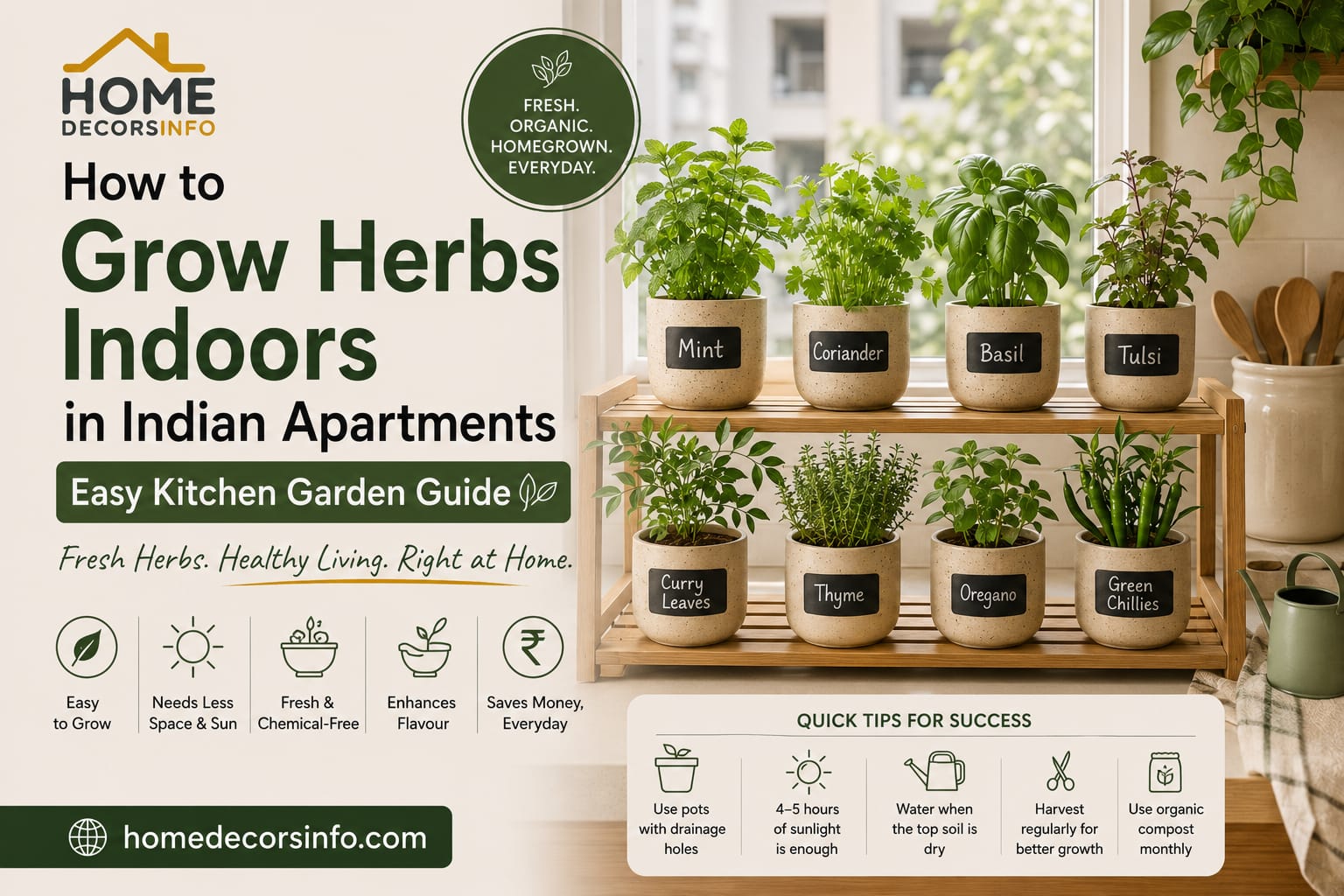
How to grow herbs indoors in Indian apartments: There is something deeply satisfying about pinching a few fresh coriander leaves from a pot on your kitchen windowsill moments before adding them to your dal, or snipping mint for your morning nimbu paani from a plant growing three feet from your stove. Growing herbs indoors is not just a gardening activity — it is a way of making your home feel more alive, more connected to what you eat, and more pleasantly fragrant throughout the day.
For Indian home cooks specifically, a small indoor herb garden makes enormous practical sense. Coriander, tulsi, curry leaves, mint, green chillies — these are ingredients that appear in Indian cooking almost daily, and buying them fresh means either regular trips to the vegetable market or watching half a bundle go limp in the refrigerator three days after purchase. A small pot of each herb on the kitchen windowsill solves both problems.
The good news is that most of the herbs used most commonly in Indian kitchens are also among the easiest plants to grow indoors. They are forgiving, fast-growing, and well-suited to the Indian climate. This guide covers everything you need to start a practical indoor herb garden in an Indian apartment — which herbs to grow, how to set them up, how to care for them, and how to keep them producing for months.
Why Growing Herbs Indoors Works Especially Well in India
India’s climate — warm temperatures year-round, a long growing season, and high ambient humidity during the monsoon — is genuinely well-suited to growing herbs indoors. Many of the herbs used in Indian cooking are tropical or subtropical plants that struggle in northern European or American indoor conditions but thrive on a sun-facing Indian kitchen windowsill.
The challenges are few but real: intense direct afternoon sun on west-facing windows in summer can scorch delicate herbs, and the dry air of air-conditioned rooms in summer can stress moisture-loving plants. Both are easily managed with a little placement thought and occasional misting. Otherwise, Indian apartment conditions are close to ideal for most kitchen herbs.
What You Need to Get Started
Containers
Terracotta pots are the best choice for herb growing in Indian conditions. They are breathable, allow excess moisture to evaporate through the sides, and prevent the overwatering that kills most indoor plants in Indian humidity. A 15 to 20 cm diameter terracotta pot is a good size for most single herb plants. Pots available at local nurseries and pottery markets for ₹30 to ₹100 per pot depending on size.
If terracotta is not available, any container with drainage holes works — repurposed tins, old pressure cooker vessels, or plastic containers. The drainage hole is non-negotiable; herbs sitting in waterlogged soil will develop root rot quickly.
For a decorative indoor herb setup that looks as beautiful as it is functional, small planters in matching ceramic or terracotta lined up on a kitchen windowsill create a genuinely lovely display. For planter ideas that work well in Indian interiors, small planter decoration ideas for apartments and small spaces has a range of attractive and affordable options.
Potting Mix
Do not use garden soil from outside for indoor herb pots — it compacts in containers, drains poorly, and may carry pests. Use a good quality potting mix available at nurseries and garden centres across India for ₹80 to ₹200 per bag. For herbs specifically, a potting mix with added perlite or coarse sand (one part coarse sand to three parts potting mix) improves drainage and suits the growing needs of most kitchen herbs well.
Location
Most herbs need 4 to 6 hours of bright light per day — either direct morning sun (east-facing window) or bright indirect light for most of the day. In Indian apartments, an east-facing kitchen windowsill is ideal. A south-facing window also works well with a sheer curtain to filter the most intense afternoon sun in summer. North-facing kitchens are the most challenging — supplement with a small grow light (₹500–₹1,500 on Amazon India) if natural light is insufficient.
The 7 Best Herbs to Grow Indoors in Indian Apartments
1. Tulsi (Holy Basil — Ocimum tenuiflorum)
Tulsi is perhaps the most culturally significant plant in Indian homes — auspicious, medicinal, and deeply familiar. It is also one of the easiest herbs to grow in an Indian apartment. It loves warmth, tolerates some direct sun, and grows vigorously in a pot on a bright windowsill. Tulsi leaves are used in herbal teas, kadha, and as an offering in daily puja — making it both a practical kitchen herb and a meaningful presence in the home.
Tulsi needs regular pruning to keep it bushy and productive — pinch off the growing tips once the plant reaches 15 to 20 cm tall, and remove flower stalks as soon as they appear (flowering causes the leaves to become bitter and the plant to stop producing new growth). A well-maintained tulsi plant on a bright windowsill can produce fresh leaves for years.
Light: Bright light — 4–6 hours of sun
Watering: When top inch of soil is dry — approximately every 2–3 days in summer
Start from: Seedlings from nursery (₹20–₹50) or cuttings from an existing plant
2. Pudina (Mint — Mentha)
Mint is one of the most useful herbs in Indian cooking and drinks — raita, chutneys, mint tea, lassi, biryanis, and chaats all use it heavily. It is also one of the most vigorous growers available — so much so that it is best grown in its own pot rather than mixed with other herbs, as it will quickly take over any shared container.
Mint prefers slightly more moisture than most other herbs and does well in partial shade — making it one of the better options for kitchens with limited direct sunlight. Keep the soil consistently moist but not waterlogged. Harvest regularly by snipping stems back to just above a leaf node — this encourages bushy, productive growth.
Light: Partial to bright indirect light — tolerates less sun than most herbs
Watering: Keep soil consistently moist — approximately every 1–2 days in summer
Start from: Cuttings placed in water (root within 1–2 weeks) or nursery seedlings (₹20–₹40)
3. Hara Dhaniya (Fresh Coriander — Coriandrum sativum)
Coriander is the herb most Indian households use in the largest quantities — on almost every dal, sabzi, raita, and chutney. Growing it at home means having it perpetually fresh rather than buying bundles that go limp within days. The challenge with coriander is that it bolts (goes to seed) quickly in warm weather — the solution is to sow a small amount of seeds every two to three weeks so there is always a fresh batch at the right stage of growth.
Sow coriander seeds directly into a pot of moist potting mix, barely covering them with a thin layer of soil. They germinate within 7 to 14 days. Begin harvesting the outer leaves once plants reach 10 to 15 cm tall. Coriander prefers cooler conditions — a bright but not too sunny spot is ideal, especially in Indian summer.
Light: Bright indirect light — avoid intense direct afternoon sun
Watering: Keep soil moist but well-drained — approximately every 2 days
Start from: Seeds — split coriander seeds from the kitchen work well (₹10–₹30 for a small packet of sowing-quality seeds)
4. Curry Patta (Curry Leaf Tree — Murraya koenigii)
Curry leaves are non-negotiable in South Indian cooking — tadkas, rice dishes, coconut chutneys, and sambar all depend on them. The curry leaf plant is a small tree that grows well in a large pot, given enough sun and warmth (both of which Indian apartments have in abundance). It is slow to get established from seed, so buy a young plant from a nursery for the fastest results.
Curry leaf plants are moderately drought-tolerant once established. They need a pot at least 30 cm in diameter to grow well, and a bright sunny spot — an east or south-facing balcony or large windowsill. Harvest individual leaves as needed rather than stripping whole stems. Available at nurseries across India for ₹50 to ₹150.
Light: Full sun — 5–6 hours daily
Watering: Allow soil to dry partially between waterings — every 3–5 days
Start from: Young nursery plant (₹50–₹150)
5. Hari Mirch (Green Chilli — Capsicum annuum)
A green chilli plant on the kitchen balcony or windowsill is one of the most practical things an Indian home cook can grow. The plants are compact (30 to 50 cm tall), highly productive once established, and continuously produce chillies for months through the growing season. One well-cared-for plant can produce 30 to 50 chillies over a season — more than enough for a regular household.
Chilli plants need significant direct sun — at least 5 to 6 hours per day — and warm temperatures, making them well-suited to most Indian apartment conditions. Water moderately, allowing the top layer of soil to dry between waterings. Feed with a balanced liquid fertiliser once a month during the growing season for best production.
Light: Full sun — 5–6 hours minimum
Watering: Moderate — allow top inch to dry between waterings
Start from: Seeds (use seeds from a fresh market chilli) or nursery seedlings (₹30–₹80)
6. Ajwain (Carom / Bishop’s Weed — Trachyspermum ammi)
Ajwain is an underrated kitchen herb that most Indian households use in parathas, pakoras, and digestive teas. The plant is compact, extremely easy to grow, and very low maintenance — tolerating some drought and variable light conditions without complaint. It has a pleasantly pungent aroma and the leaves can be used fresh in cooking just as the seeds are.
Ajwain grows well in small pots on a bright windowsill and needs minimal attention — water when dry, harvest leaves regularly to encourage new growth, and give it occasional liquid fertiliser for continued production. Available as seedlings at many nurseries or easily grown from seeds.
Light: Bright indirect to some direct light
Watering: Allow soil to dry between waterings — fairly drought-tolerant
Start from: Seeds or nursery seedlings (₹20–₹60)
7. Methi (Fenugreek — Trigonella foenum-graecum)
Methi leaves are used extensively in North Indian cooking — methi paratha, methi dal, methi chicken, and aloo methi are all household staples. Fenugreek grows very quickly from seed (germinating within 4 to 5 days and ready for first harvest within 2 to 3 weeks) and can be grown in shallow containers, making it ideal even for the smallest apartment kitchen garden. Like coriander, staggered sowing every two weeks ensures a continuous supply.
Methi prefers cooler months and may bolt quickly in intense summer heat. It is an ideal autumn and winter kitchen herb for most Indian climates.
Light: Bright indirect to some direct light
Watering: Keep soil moist — approximately every 1–2 days
Start from: Methi seeds from the kitchen — soak overnight for faster germination
Setting Up Your Indoor Herb Garden: Step-by-Step
- Choose your location: Identify the brightest spot in your kitchen — ideally an east-facing windowsill or a counter near a bright window. If you have a small balcony attached to the kitchen, that is even better for sun-loving herbs like chilli and curry leaves.
- Select your pots: Start with 3 to 4 terracotta pots in 15–20 cm diameter. One per herb initially. Ensure each has a drainage hole and a saucer beneath.
- Prepare your potting mix: Fill each pot to about 2 cm from the top with potting mix mixed with a small amount of coarse sand or perlite for drainage.
- Plant or sow: For seedlings, make a hole slightly larger than the root ball, set the plant in place, and firm the soil gently around it. For seeds (coriander, methi, chilli), follow the sowing depth instructions on the seed packet — typically 0.5 to 1 cm deep.
- Water gently: Water thoroughly after planting until water drains from the bottom. Do not water again until the top layer of soil has dried out.
- Label your pots: A small handwritten label or a wooden ice-cream stick with the herb name saves confusion once everything starts growing.
- Harvest regularly: Regular harvesting is not just practical — it encourages the plant to produce more new growth. Never harvest more than one-third of a plant at a time.
Quick Reference: All 7 Herbs at a Glance
| Herb | Light | Water | Difficulty | Best Season |
|---|---|---|---|---|
| Tulsi | Bright / some direct | Every 2–3 days | Easy | Year-round |
| Mint | Partial / indirect | Daily in summer | Very easy | Year-round |
| Coriander | Bright indirect | Every 2 days | Easy | Oct–March |
| Curry Leaf | Full sun | Every 3–5 days | Moderate | Year-round |
| Green Chilli | Full sun | Every 2–3 days | Easy | March–Oct |
| Ajwain | Bright indirect | Every 3–4 days | Very easy | Year-round |
| Methi | Bright indirect | Daily | Very easy | Oct–Feb |
Common Problems and How to Fix Them
Yellowing Leaves
Usually a sign of overwatering. Allow the soil to dry more completely between waterings and ensure the pot has adequate drainage. If the problem persists, check for root rot — if roots are brown and mushy, repot the plant into fresh dry soil and reduce watering significantly.
Leggy, Stretched Growth: how to grow herbs indoors in Indian apartments
The plant is not getting enough light. Move closer to the window or supplement with a grow light. Leggy herbs produce fewer leaves and less flavour — light is the most common limiting factor in Indian indoor herb gardens.
Tiny White Insects (Whitefly or Aphids)
Common in Indian conditions, especially on chilli and tulsi plants. Spray the plant thoroughly with a diluted neem oil solution (1 ml neem oil + 1 ml dish soap + 1 litre water) every 3 days for two weeks. Neem oil is widely available at nurseries and garden centres across India for ₹80 to ₢200.
Rapid Bolting (Flowering and Going to Seed)
Common with coriander and methi in warm weather. Pinch off flower stalks as soon as they appear to prolong the leaf-producing life of the plant. For coriander especially, shifting to a cooler spot and sowing fresh seeds every few weeks is the most practical long-term solution.
For more general guidance on caring for plants in Indian apartment conditions, the National Horticulture Board of India provides climate-specific gardening information at nhb.gov.in — a reliable reference for both herb and general plant care in Indian conditions.
If you have a balcony, combining your indoor herb setup with a small balcony garden can significantly expand what you are able to grow. How to create a calm balcony garden for a small apartment covers the full balcony setup process with Indian conditions and budgets in mind.
Conclusion
An indoor herb garden in an Indian apartment is one of the most practical, affordable, and genuinely pleasurable home projects you can start this weekend. Begin with just two or three pots — tulsi for its cultural meaning and daily usefulness, mint for its versatility and ease, and either coriander or methi depending on the season. Give them the right light, water them when the soil dries, and harvest regularly. Within a few weeks, you will have fresh herbs available whenever you cook, your kitchen will smell wonderful, and your windowsill will have a quality of life and beauty that no decoration can quite replace.
For tools that make maintaining your indoor garden easier, smart gardening tools for beginners starting their first home garden covers the practical essentials at every budget level.
Frequently Asked Questions
Which herbs grow best indoors in Indian summers?
Tulsi, green chilli, ajwain, and mint are the best performers in Indian summer conditions. Coriander and methi are better suited to the cooler months of October through February — they bolt quickly in intense summer heat. If you want a productive indoor herb garden year-round, maintain tulsi, chilli, and ajwain through summer and add coriander and methi from October onwards.
Can I grow herbs indoors without a balcony?
Yes, absolutely. A bright east-facing kitchen windowsill is sufficient for most Indian kitchen herbs. The key requirement is adequate light — 4 to 6 hours of bright light per day. If your kitchen does not have a bright window, a small LED grow light mounted under a kitchen cabinet or on a shelf provides enough supplemental