Table of Contents
- 1 Step 1 — Diagnose Before You Act
- 2 Step 2 — The Most Common Problem: Overwatering and Root Rot
- 3 Step 3 — The Second Most Common Problem: Underwatering
- 4 Step 4 — Root Bound Plants
- 5 Step 5 — Pest Infestations
- 6 Step 6 — Positioning Problems
- 7 The Recovery Timeline: What to Expect
- 8 When to Accept That a Plant Cannot Be Saved
- 9 Conclusion
- 10 Frequently Asked Questions
How to revive a dying indoor plant in India: Every plant owner has been there. A plant that was thriving a few weeks ago is now yellowing, drooping, dropping leaves, or looking so limp and sad that the honest question is whether it is already too late. Before giving up and throwing the plant away, it is worth knowing that most dying indoor plants can be revived — often with surprisingly simple interventions — once you correctly identify what is actually wrong with them.
In Indian households specifically, the most common causes of indoor plant decline are well-defined and largely predictable: overwatering during the monsoon, underwatering during travel or a busy period, root rot from inadequate drainage, sun scorch from a position change in summer, and pest infestations that are noticed too late. Each of these has a specific rescue approach, and the earlier it is identified, the higher the survival rate.
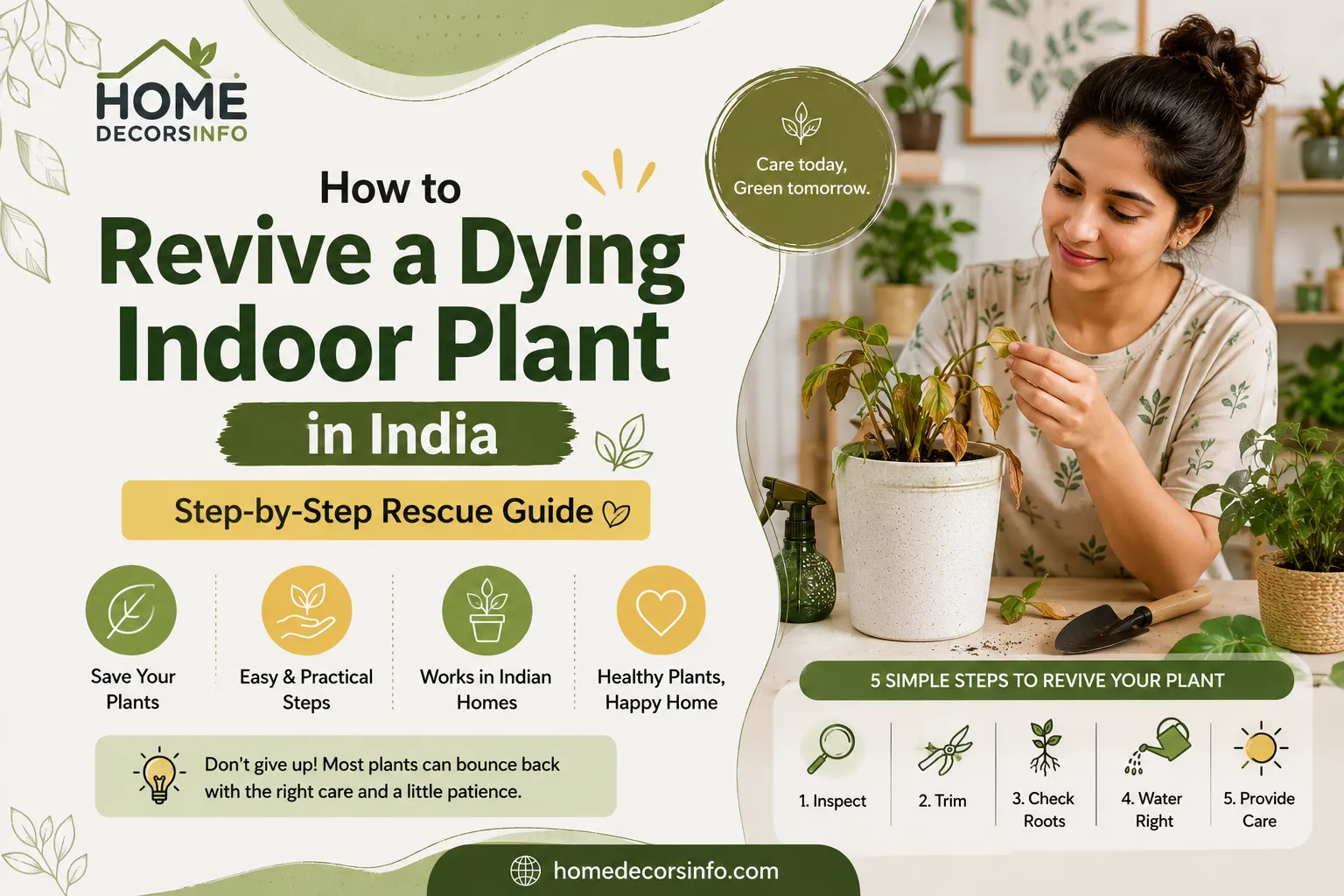
This guide walks through the complete process of diagnosing what is wrong with a dying indoor plant and applying the right rescue intervention — step by step, with specific guidance for Indian indoor conditions and the most common Indian apartment plants.
Step 1 — Diagnose Before You Act
The most common mistake when trying to save a dying plant is acting before diagnosing. Watering a plant that is dying from overwatering kills it faster. Moving a sun-starved plant into direct afternoon Indian summer sun causes immediate scorch. Before doing anything, spend five minutes carefully observing the plant and checking its soil and roots. The symptoms the plant is showing will tell you almost everything you need to know about what is wrong.
Read the Symptoms
| Symptom | Most Likely Cause | Secondary Possibility |
|---|---|---|
| Yellow leaves — soft and mushy stems | Overwatering / root rot | Poor drainage |
| Yellow leaves — dry crispy edges | Underwatering or low humidity | Too much direct sun |
| Wilting despite moist soil | Root rot — roots unable to absorb water | Root bound (too crowded in pot) |
| Wilting with bone-dry soil | Underwatering | Root bound — soil dries too fast |
| Brown crispy leaf tips | Low humidity / fluoride in tap water | Underwatering or root bound |
| Brown patches on leaves | Sun scorch (direct afternoon sun) | Fungal disease |
| Sticky residue on leaves | Scale insects or mealy bugs | Aphid infestation |
| White powdery coating on leaves | Powdery mildew (fungal) | Hard water mineral deposits |
| Rapid leaf drop — still green | Sudden temperature change or draught | Root disturbance or repotting shock |
| Leggy, stretched growth toward light | Insufficient light | Wrong light type (direct vs indirect) |
Check the Soil and Roots
After observing the above-ground symptoms, check the soil by pushing a finger 3 to 4 cm into the potting mix. Is it bone dry, slightly moist, or soggy and wet? Then — if the symptoms suggest overwatering or root rot — gently remove the plant from its pot and examine the roots. Healthy roots are white to cream coloured and firm. Rotted roots are brown, black, mushy, and may smell unpleasant. The proportion of rotted to healthy roots tells you how serious the problem is and whether recovery is likely.
Step 2 — The Most Common Problem: Overwatering and Root Rot
Overwatering is responsible for the majority of indoor plant deaths in Indian homes — particularly during the monsoon when ambient humidity is high, soil dries slowly, and well-meaning plant owners continue watering on their regular schedule rather than adjusting to conditions. Root rot — caused by roots sitting in waterlogged soil — kills plants slowly from the roots upward, and by the time symptoms are visible above ground, the damage is often already significant.
How to Save an Overwatered Plant
- Remove from pot immediately. Gently tip the plant out and shake off as much of the wet soil as possible without disturbing the remaining healthy roots.
- Inspect the roots. Identify which roots are rotted (brown, mushy, smelly) and which are still healthy (white or cream, firm).
- Prune rotted roots. Using clean scissors or pruning shears (wipe with diluted rubbing alcohol between cuts to prevent spreading rot), cut off all rotted roots back to firm, healthy tissue. If more than 70 per cent of the roots are rotted, recovery is unlikely but still worth attempting.
- Treat with fungicide or cinnamon powder. Dust the cut root ends and remaining healthy roots with plain cinnamon powder — a natural antifungal available in every Indian kitchen — or with a diluted neem oil solution. This inhibits further fungal growth and gives the remaining roots a better chance.
- Repot in fresh, dry, well-draining mix. Prepare a new potting mix with additional coarse sand or perlite for improved drainage (3 parts potting mix : 1 part coarse sand). Use a clean pot with good drainage holes — ideally a terracotta pot which allows excess moisture to evaporate through the sides. Do not reuse the old potting mix, which may still harbour the fungal organisms that caused the rot.
- Water minimally for 2 to 3 weeks. After repotting, resist the urge to water immediately. Wait until the top 3 to 4 cm of soil is completely dry before the first watering. The stressed root system needs to recover in a dry environment before resuming normal watering.
- Place in bright indirect light. A recovering plant should not be under direct sun stress. Bright indirect light is the ideal recovery position — enough to support photosynthesis without adding heat or UV stress.
Step 3 — The Second Most Common Problem: Underwatering
Underwatering is most common during travel, busy periods, or Indian summer when pots dry out within 24 hours. A severely underwatered plant wilts dramatically — leaves droop and curl, soil pulls away from the pot edges, and the pot feels very light when lifted.
How to Save an Underwatered Plant: how to revive a dying indoor plant in India
- Check whether the soil is hydrophobic. Severely dry potting mix can become hydrophobic — water runs straight off the surface without soaking in. If water puddles on top and drains immediately without being absorbed, the soil needs rehydration before a normal watering approach will work.
- Soak the pot in water. Place the entire pot in a bucket of room-temperature water and allow it to soak for 30 to 60 minutes. The soil will gradually absorb water from the bottom up. This is the most effective way to rehydrate severely dry soil and ensure water reaches the root zone rather than running straight through.
- Drain thoroughly. After soaking, allow the pot to drain completely before returning it to its position. Do not leave it sitting in water.
- Trim dead and crispy growth. Remove any leaves or stems that are completely dead — brown, crispy, and with no green remaining. These will not recover and removing them redirects the plant’s limited energy toward new growth.
- Resume regular watering based on soil moisture. After the rescue soak, return to a watering schedule based on checking the soil — when the top 2 to 3 cm is dry, water thoroughly. Do not overcompensate for the dry period by watering every day — this leads straight to overwatering problems.
Most underwatered plants that have not completely dried out begin showing signs of recovery within 24 to 72 hours of the rescue soak — leaves lift and unfurl, the stem becomes firmer. The brown crispy tips and edges do not recover (cut these off cleanly with scissors) but new growth emerges healthy from the same nodes within 1 to 2 weeks.
Step 4 — Root Bound Plants
A root-bound plant — one where the roots have filled the pot entirely and have nowhere left to grow — shows a specific set of symptoms: wilting despite regular watering (the dense root mass leaves no room for water retention), soil that dries out extremely quickly, roots visibly emerging from the drainage holes or above the soil surface, and stunted or yellowing growth despite adequate light and water.
How to Repot a Root-Bound Plant
- Choose a new pot that is 4 to 6 cm larger in diameter than the current pot — no more. A pot that is too large holds excess moisture around the roots and can trigger root rot.
- Gently remove the plant from the old pot. If it is stuck, run a knife around the inside edge of the pot to loosen it.
- Loosen the root ball by gently teasing the outer roots apart with your fingers or a chopstick. This encourages roots to grow outward into the new soil rather than continuing to circle.
- Trim any dead, broken, or excessively long circling roots with clean scissors.
- Add fresh potting mix to the base of the new pot, position the plant, and fill around the root ball with fresh mix. Water thoroughly after repotting.
- Expect repotting shock — some wilting and leaf drop in the first 1 to 2 weeks is normal as the plant adjusts. Place in a slightly shaded position and do not fertilise for 4 to 6 weeks after repotting.
Step 5 — Pest Infestations
Common pests in Indian indoor plants include mealy bugs (white cottony clusters in leaf axils), scale insects (brown bumps on stems), spider mites (fine webbing on leaves, particularly in dry air-conditioned rooms), and whitefly (clouds of small white insects when the plant is disturbed). All of these are treatable when caught early.
Treatment Protocol
- Isolate the affected plant immediately — pests spread easily between plants in close proximity.
- Remove visible pests manually — use a cotton swab dipped in diluted rubbing alcohol (70 per cent) to remove mealy bugs and scale insects from their positions. This immediate mechanical removal is the fastest first step.
- Spray with neem oil solution — mix 2 ml neem oil with 1 ml dish soap per litre of water. Spray all surfaces of the plant thoroughly — top and underside of all leaves, stems, and the soil surface — every 3 days for 2 weeks. Neem oil is available at nurseries across India for ₹80 to ₹200 per 100 ml and is effective against most common Indian indoor plant pests.
- Monitor for 4 weeks — even after apparent elimination, continue inspecting the plant weekly for a month. Pest eggs hatch in cycles and a second generation can appear 2 to 3 weeks after the adults have been cleared.
- Reintroduce to other plants only after 4 pest-free weeks.
Step 6 — Positioning Problems
Many Indian indoor plants decline not from watering problems or pests but from being in the wrong position — too much direct afternoon sun in summer, too little light in a north-facing room, or too close to an air conditioner vent that creates dry, cold airflow the plant cannot tolerate.
Sun Scorch Recovery
Move the plant immediately to bright indirect light. The scorched leaves will not recover — trim them cleanly once they are fully dried. New growth from the same stems will emerge without scorching once the plant is in the correct position. In Indian summer, even plants that tolerate direct sun during cooler months may need protection from the intense 12 PM to 4 PM sun through a sheer curtain or relocation.
Low Light Recovery
Move to the brightest available indirect light position. Leggy, stretched growth caused by insufficient light cannot be reversed in existing stems — trim leggy growth back to a healthy node to encourage compact new growth in better light conditions. Supplement with a grow light (₹500 to ₹1,500 on Amazon India) if the flat genuinely has insufficient natural light for the plant’s needs.
The Recovery Timeline: What to Expect
| Problem | First Signs of Recovery | Full Recovery Time |
|---|---|---|
| Mild overwatering (caught early) | 2–5 days | 2–4 weeks |
| Root rot (moderate) | 1–2 weeks | 4–8 weeks |
| Underwatering (severe) | 24–72 hours | 1–3 weeks |
| Root bound — repotted | 2–3 weeks (after shock) | 4–6 weeks |
| Pest infestation (treated) | 1–2 weeks | 4–6 weeks monitoring |
| Sun scorch — repositioned | 1–2 weeks (new growth) | 4–8 weeks |
For additional guidance on keeping Indian apartment plants healthy from the start — so rescue interventions are rarely needed — 8 best indoor plants for Indian apartments that are easy to grow covers the low-maintenance plant choices that are most forgiving in Indian conditions. And for setting up a self-watering system that prevents the most common cause of plant decline — inconsistent watering — easy self-watering plant setups for busy homeowners is a practical next read.
The National Horticulture Board of India also provides useful plant care guidance suited to Indian conditions at nhb.gov.in — a reliable reference for diagnosing plant problems in the Indian climate context.
When to Accept That a Plant Cannot Be Saved
Not every dying plant can be rescued — and recognising when a plant is beyond recovery is as important as knowing how to attempt a rescue. Signs that a plant is likely too far gone to save:
- All roots are completely rotted — brown, mushy, with no firm white roots remaining
- The main stem is completely soft, brown, and mushy from the base upward
- All leaves have dropped and no green growth remains on any stem
- Severe pest infestation that has spread throughout the entire plant including the roots
In these cases, the kindest and most practical response is to let the plant go. Compost what can be composted (stems and leaves that are not diseased), sterilise the pot thoroughly before reusing it, and choose a new plant — ideally one better suited to the conditions that caused the previous plant’s decline. Every dead plant is information: it tells you something specific about the growing conditions in your home that you can apply to better choices and better care going forward.
Conclusion
A dying indoor plant is almost always giving you clear information about what it needs — the symptoms are specific and the solutions are knowable. Most Indian apartment plant deaths are caused by overwatering, and most overwatered plants can be rescued if the root rot is caught before it claims the entire root system. The key is observation and early action: check your plants weekly, learn to read the symptoms, and act as soon as something looks wrong rather than waiting to see if it resolves on its own. A plant that shows distress is asking for help, and most of the time, help given promptly is enough to bring it back.
Frequently Asked Questions
How do I know if my plant has root rot or is just underwatered?
The key test is the soil moisture check. Push a finger 3 to 4 cm into the soil — if it is wet or damp and the plant is wilting, root rot is the most likely cause (the roots cannot absorb water even though it is present). If the soil is bone dry and the plant is wilting, underwatering is the cause. Remove the plant from the pot if in doubt — healthy roots are white and firm, rotted roots are brown, mushy, and often smell unpleasant. This visual check confirms the diagnosis immediately and definitively.
Can I save a plant if all the leaves have fallen off?
It depends on whether the stems are still alive. Scratch the bark of a stem lightly with a fingernail — if there is green tissue visible beneath the surface, the stem is still alive and the plant may recover. If the stem is brown and dry all the way through, that part of the plant is dead. Check multiple stems — some may be alive even if others are not. A plant with at least one living stem can often recover, particularly if it has a strong root system. Water sparingly and place in good indirect light. New growth may take 2 to 4 weeks to appear but can emerge from apparently bare stems.
My snake plant or ZZ plant is yellow and mushy — can it be saved?
Snake plants and ZZ plants are both prone to overwatering and can develop mushy, yellowing growth when their roots have rotted. Both have storage organs — rhizomes in ZZ plants and the thick succulent leaves of snake plants — that may still be viable even when the above-ground growth looks very poor. Remove from the pot, cut away all rotted